Distribution: Occurring east of the Cascades crest in Washington; central Washington to north-central and northeastern Oregon.
Habitat: Dry, open, often rocky slopes at low to moderate elevations.
Flowers: June-August
Origin: Native
Growth Duration: Perennial
Conservation Status: Not of concern
Pollination: Bumblebees, bees, hummingbirds
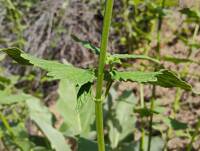
Perennial herbs from fibrous roots and branching, woody base, the numerous, square stems simple or branched, 4-8 dm tall, glabrous or finely puberulent.
Leaves opposite, petioles 1-5 cm long, the blades ovate to deltoid, with rounded teeth, up to 6 cm long and 4 cm wide, glabrous or finely scabrous on the upper surface, and with very short, fine, tangled-woolly hairs on the lower surface.
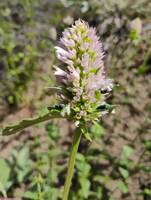
Inflorescence spike-like, 3-15 cm long; calyx prominently veined, the 5 equal teeth 3-5 mm long, narrowly triangular, acuminate, usually tinged with lavender-purple; corolla whitish to lavender, 10-14 mm long, two-lipped, with short lobes; stamens 4, exerted, the upper pair longer than the lower; style slender, 2-parted; ovary superior, 2-celled.
Fruit of 4 nutlets.
Publication: Muhlenbergia; a journal of botany 1(1): 4. 1900.
PNW Herbaria: Specimen records of Agastache occidentalis in the Consortium of Pacific Northwest Herbaria database
WA Flora Checklist: Agastache occidentalis checklist entry
OregonFlora: Agastache occidentalis information
E-Flora BC: Agastache occidentalis atlas page
CalPhotos: Agastache occidentalis photos